
In traditional development environments, troubleshooting typically relied on analyzing saved log files after an issue had occurred.
Engineers had to search through massive log files to locate the relevant entries, examine the details, narrow down the possibilities, and then reconstruct the steps that led to the problem. This process required significant time and effort.
Issues caused by parallel processing or those that occur only rarely were especially difficult to diagnose, often making root‑cause identification extremely challenging. As a result, development efficiency and product quality were frequently impacted.
In Debugging
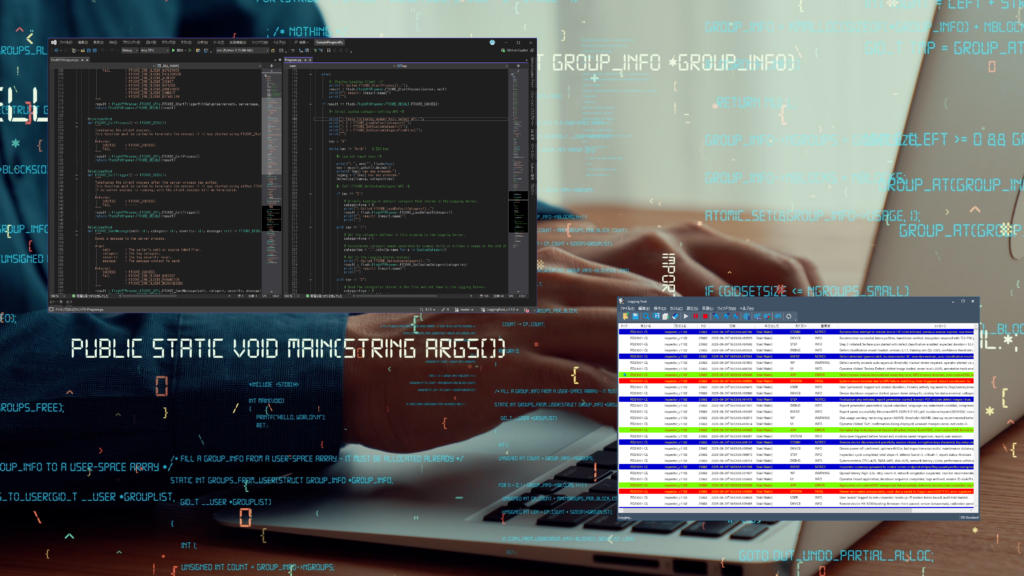
Traditional logging methods such as using print statements provide real‑time output, but they only work while a debugger is attached and cannot be stored as log files.
On the other hand, file‑based logging allows logs to be saved, but it lacks real‑time visibility. In addition, the output format and level of detail often vary from developer to developer, resulting in inconsistent logs that make comparison with normal behavior and troubleshooting significantly more difficult.
By introducing Logging Foot, these challenges are resolved at once.
Simply replacing traditional print‑based output with Logging Foot allows you to maintain real‑time visibility while displaying logs in a consistent format—regardless of the developer—and saving them to files at the same time. This enables a unified logging approach that supports both development and future operational needs.
In Development
In many development environments, engineers often analyze log files after the fact to identify reproduction steps and narrow down the root cause of an issue.
However, problems that do not occur in debugging environments, issues with low reproduction frequency, or failures caused by parallel processing can require significant time and effort to diagnose.

By monitoring logs in real time, you can pause execution the moment an anomaly is detected and attach a debugger immediately. This allows you to approach the problematic area on the spot. Such rapid response dramatically accelerates issue identification and resolution, leading to substantial improvements in development efficiency and overall product quality.
In Maintenance and Operations

Real‑time log monitoring is highly effective even in always‑running systems such as those found in manufacturing environments.
By executing actions like backups or rollbacks immediately when an abnormal log is detected, you can minimize the impact on the system and maintain stable, continuous operation.